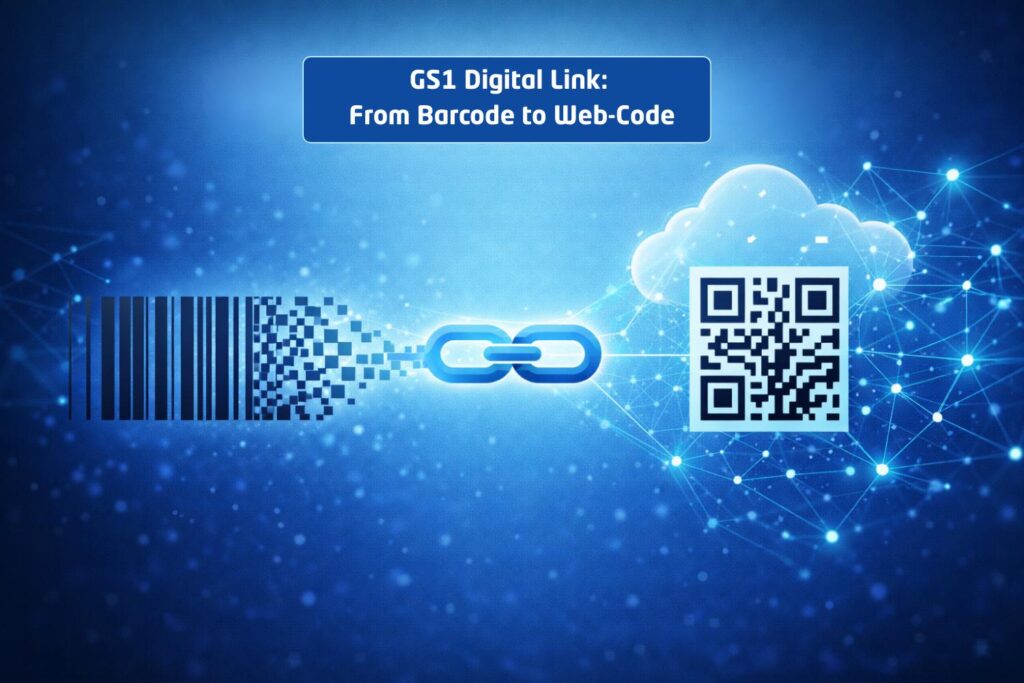
Since its introduction, the traditional barcode has been the cornerstone of logistics and retail, providing a static identifier that is essential for checkout scanning, inventory management, and warehouse handling. In an increasingly connected world, where consumers demand real-time transparency and immediate product information, the need for this evolution has become imperative.
GS1 Digital Link, the global standard that transforms the product identifier from a simple alphanumeric code to a web address, has arrived. Essentially, the Digital Link effectively “enables the web” for barcodes, usually encoded in a 2D, QR, or Data Matrix code, making them a dynamic portal for digital content. This revolution has been made possible by the widespread use of mobile devices, specifically smartphones, whether running on Android or iOS.
What is GS1 Digital Link?
GS1 Digital Link is the standard promoted by GS1 (the global organization for product and location identification standards) that encodes GS1 identifiers (such as GTIN, Global Trade Item Number) alongside other important data (e.g., batch number or expiration date) in a standardized URL structure.
When a consumer or operator scans this code, the system interprets the address and, thanks to software called Resolver, directs the user or system to the correct digital destination, a web page.
Advantages of a Single Code
The true revolution lies in the implementation of a single 2D barcode (containing the GS1 Digital Link) that can perform multiple functions, eliminating the need to print multiple codes on the same packaging.
➜ Scanning at checkout: The point-of-sale system efficiently extracts the GTIN for payment processing.
➜ Consumer information: The smartphone redirects the user to a web page that provides product details, instructions, videos, recipes, or information on sustainability, nutritional quality, warnings about additives or intolerances, and the production process.
➜ Traceability: Supply chain systems access vital data on the batch, serialization, or expiration date.
What are the key advantages for businesses and consumers?
The use of GS1 Digital Link offers significant benefits throughout the value chain, from production to the end consumer.
For Brands and Supply Chain
1. Improved Traceability: This system enables real-time tracking at the individual item level, facilitating inventory management and accelerating recalls of specific products in the event of problems, resulting in greater logistical efficiency and lower costs.
2. Simplified operations: The ability to use a single code simplifies labeling, optimizing valuable space on packaging, and reduces handling errors caused by multiple codes.
3. Compliance with Rules and Regulations: It helps companies comply with evolving regulatory requirements, such as the future Digital Product Passports (DPP) in the European Union, by providing standardized access to all necessary information.
4. Dynamic Management: Linked information can be updated digitally at any time without the need to change the physical code printed on the product; the label becomes a portal to other content.
For Consumers
1. Clarity: Consumers receive immediate access to thorough and verifiable information directly on their smartphones: ingredients, allergens, origin, certifications, and instructions for properly disposing of packaging.
2. Interactive experiences: The code serves as a direct point of contact with the brand, providing personalized content, promotions, loyalty programs, free products, or after-sales support.
3. Trustworthiness: The ability to verify the authenticity of the product and the status of a recall (if any) in real time enhances trust and confidence in the brand.
Future is Here: Horizon 2027
Global retail is undergoing a significant transition to embrace 2D barcodes, including GS1 Digital Link. The hardware transformation is expected to encounter challenges, particularly for small, unaffiliated retailers and regions of the world where the digital divide is especially noticeable. In some regions, such as the United States, a target date of Sunrise 2027 has been established, by which point point-of-sale systems will need to be equipped to read and process 2D codes as standard.
This transition does not mark the immediate end of the 1D barcode era; rather, it facilitates the adoption of Digital Link, which represents not only a technical improvement but also a genuine strategy for creating smarter, safer, and more efficient product-digital interaction.